What “Reef-Safe” Actually Means
“Reef-safe” sounds like a real category, something inspected and approved before it makes it onto a bottle. It isn’t. No federal or state agency defines, certifies, or verifies the term “reef-safe” or “reef-friendly” on a sunscreen label. Any brand can print it without meeting a legal standard, because there isn’t one to meet.
That doesn’t mean nothing here is regulated, or that the science behind the term is made up. A handful of places have passed real laws restricting specific chemicals in sunscreen, and the research behind those laws holds up under scrutiny. It just means the word on the label, by itself, isn’t proof of anything. Here’s what’s actually true, and where most sunscreen guides get it wrong.
The short answer
“Reef-safe” and “reef-friendly” are marketing terms, not legal or scientific ones. The FTC requires that environmental marketing claims be backed up, but no agency has ever set a specific definition for what “reef-safe” has to mean, so brands use the phrase however they like. In practice, it usually signals that a sunscreen leaves out one or two specific chemicals, oxybenzone and octinoxate, that a small number of places have restricted by law. It does not signal that the product has been independently tested for reef impact or verified by any third party. Outside of the handful of laws below, nothing requires that testing to happen, so for most products carrying the label, it hasn’t.
Why the term exists
Concern over sunscreen’s effect on coral reefs picked up momentum after a 2016 study, published in Archives of Environmental Contamination and Toxicology and hosted in NOAA’s own research library, found that oxybenzone caused increased coral bleaching susceptibility, DNA damage, and deformities in coral larvae at concentrations detected in reef waters near Hawaii and the U.S. Virgin Islands. A separate 2013 study found similarly toxic effects from benzophenone-2, another UV filter, at very low concentrations.
That research is real, and NOAA’s own marine science office has published on it directly. But
Cosmetic chemist Michelle Wong breaks down the coral research behind these claims in more depth:
It’s worth being precise about NOAA’s actual role here: the agency funds and conducts the underlying research through its National Centers for Coastal Ocean Science. It does not regulate what sunscreen gets sold in a store. That authority sits with state and local governments, and only a few have used it.
What’s actually banned, and where
This is the part most sunscreen guides get wrong, or leave out entirely, so it’s worth laying out plainly:
| Jurisdiction | What’s restricted | Status today | Effective date |
|---|---|---|---|
| Hawaii (statewide) | Sale of sunscreen containing oxybenzone or octinoxate, without a prescription | In effect | January 1, 2021 (HRS Chapter 342D, enacted via SB2571, 2018 session) |
| Maui County, HI | Sale, distribution, and use of non-mineral sunscreen without a prescription; permitted mineral sunscreens must use non-nano zinc oxide or titanium dioxide | In effect, stricter than state law | October 1, 2022 |
| Hawaii County (Big Island) | Sale of non-mineral sunscreen without a prescription; personal use of other sunscreen is not restricted | In effect | December 1, 2022 |
| U.S. Virgin Islands | Sale of sunscreen containing oxybenzone, octinoxate, or octocrylene | In effect | March 30, 2020 |
| Key West, FL | A 2019 local ordinance banning sale of oxybenzone and octinoxate sunscreen | Never took effect. Florida’s SB 172 gave the state exclusive authority to regulate these products, preempting Key West’s ordinance before its scheduled start date. | N/A |
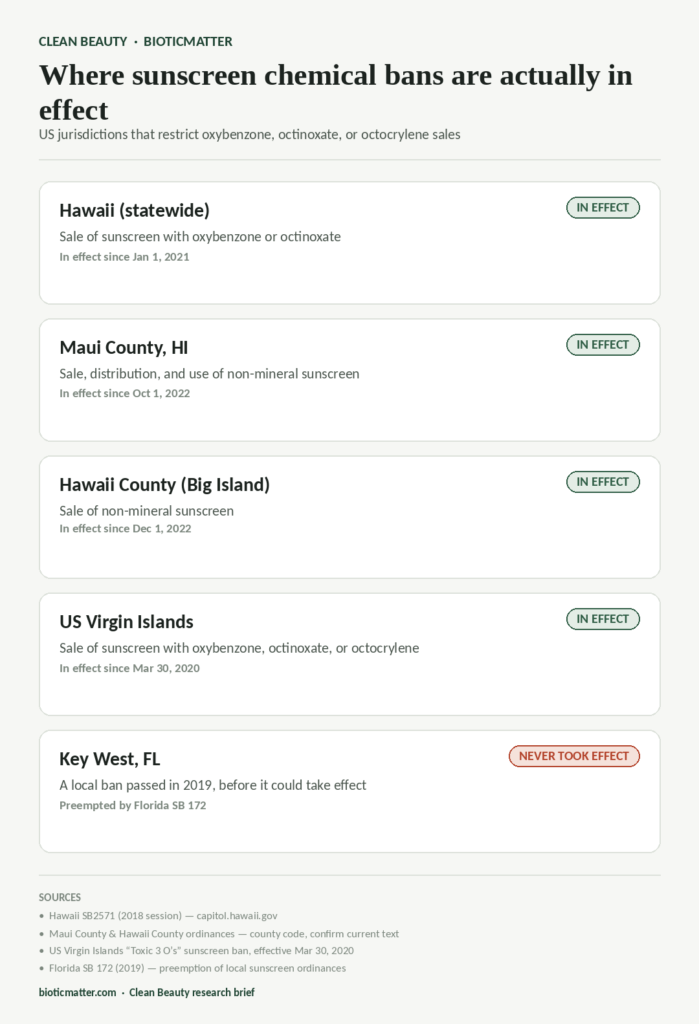
A note on that last row, since it’s the detail most competing guides miss entirely: Key West did pass a sunscreen ordinance in 2019, and plenty of articles still describe it as active. It isn’t, and hasn’t been since before it was ever enforced. Florida’s legislature passed a law in 2019 giving the state exclusive authority to regulate the sale of over-the-counter drugs and cosmetics, which preempted Key West’s ordinance before its scheduled 2021 start date. If a source tells you to avoid certain sunscreens specifically because of a Key West ban, that source is out of date.
Oahu and Kauai follow only the statewide Hawaii law described above; neither county has passed anything stricter.
What “reef-safe” doesn’t guarantee
No FDA, EPA, or state agency certifies or verifies a “reef-safe” claim on packaging, full stop. A sunscreen can legally call itself reef-safe while containing ingredients that sit entirely outside the handful of chemicals actually restricted anywhere, ingredients like octocrylene, avobenzone, or homosalate. Some of these are still being studied for environmental effects, but none of them are currently banned at the state or territory level the way oxybenzone and octinoxate are.
Mineral filters (non-nano zinc oxide and titanium dioxide) are the closest thing to a research-backed lower-impact choice, and they’re what every law listed above eventually points back to. But “mineral” and “reef-safe” aren’t interchangeable claims either. Maui County’s ordinance specifically requires non-nano particle size, because there’s a genuinely open question in the research about whether nanoparticle mineral filters carry their own environmental risks. A sunscreen can be entirely mineral-based and still use nano-sized particles, so “mineral” on its own doesn’t settle the question the way “non-nano mineral” does.
How to actually evaluate a sunscreen’s claim
Skip the front label and read the active ingredients on the back.
- If oxybenzone or octinoxate is listed, it isn’t compliant with any of the laws above, regardless of what the front of the bottle says.
- If the actives are listed as non-nano zinc oxide or titanium dioxide, it clears the strictest standard currently set by any U.S. jurisdiction, Maui County’s.
- Everything else, chemical filters other than the two named above, sits in a gray area that current law simply doesn’t address, one way or the other.
That’s a narrower, more useful test than anything printed on the front of the bottle.
Frequently asked questions
Is “reef-safe” a legal term?
No. It isn’t defined or regulated by any US federal or state agency. It’s a marketing term a brand chooses to use.
What chemicals does Hawaii’s sunscreen law actually ban?
The statewide law restricts the sale of sunscreen containing oxybenzone or octinoxate without a prescription, effective since January 1, 2021. Maui County and Hawaii County have since passed stricter local rules requiring mineral-only formulas.
Is Key West’s sunscreen ban still in effect?
No. Key West passed a local ban in 2019, but Florida’s state legislature preempted local sunscreen regulation before the ban’s scheduled 2021 start date, so it never took effect.
Are mineral sunscreens automatically reef-safe?
Not automatically. Mineral filters, zinc oxide and titanium dioxide, are the best-supported option under current research and law, but nano-sized mineral particles are a separate, still-debated question, specific enough that Maui County’s ordinance calls it out by name.
Does NOAA certify reef-safe sunscreen?
No. NOAA funds and publishes research on how certain chemicals affect coral, but it doesn’t regulate, certify, or approve sunscreen products.
Bottom line
“Reef-safe” on a label means whatever the brand decided it means, nothing more. What’s actually enforceable is much narrower and more specific: two chemicals restricted under Hawaii state law, a stricter mineral-only rule in two Hawaii counties, three chemicals restricted in the U.S. Virgin Islands, and nothing currently in effect in Florida. Everything else on a sunscreen label is worth reading with that in mind.
This is the same standard we hold ourselves to. See our Research & Review Standards page for how BioticMatter sources the regulatory and scientific claims behind everything we cover.